
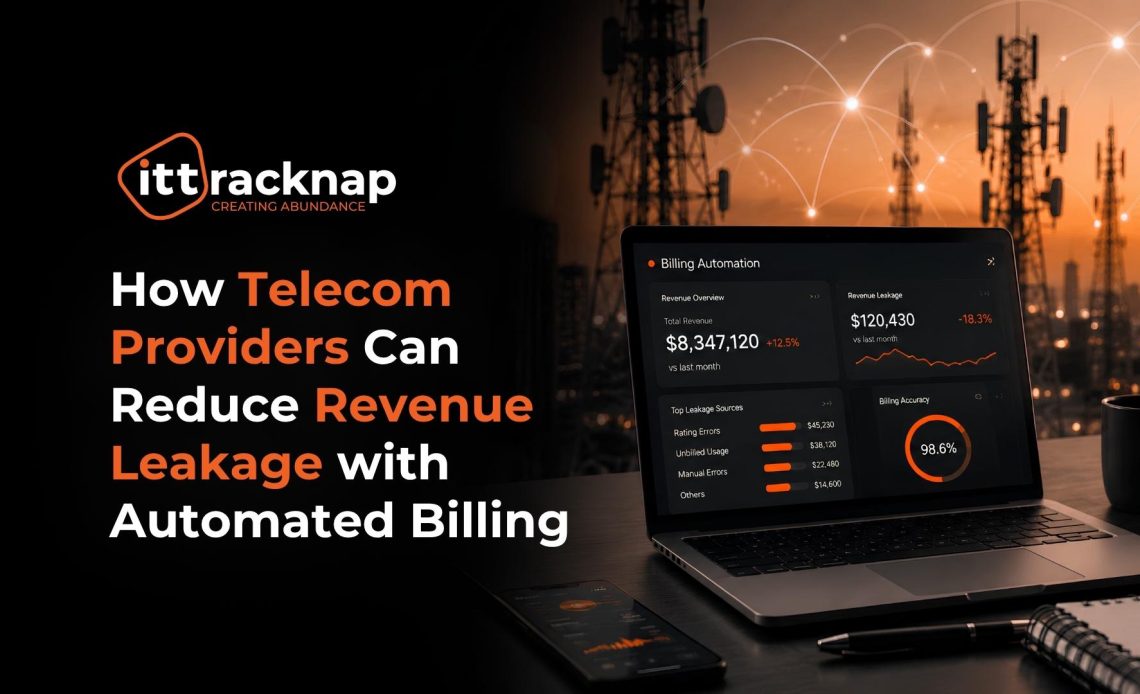
Telecom providers operate across complex networks, products, partners, pricing models, and customer agreements. With multiple systems involved in usage, provisioning, charging, and invoicing, even small gaps can cause revenue to slip through unnoticed.
Revenue leakage can result from missing usage records, incorrect rates, outdated discounts, provisioning errors, or invoice discrepancies. Automated billing can help providers identify these gaps earlier, improve billing accuracy, and protect the revenue they have already earned.
According to TM Forum, non-fraudulent billing mistakes can account for around 2.92% of total revenue. For telecom providers, even a small percentage can represent millions in lost revenue. As telecom services become more complex, billing accuracy has become increasingly important for protecting margins and maintaining customer trust.
In this blog, we’ll explore the common causes of revenue leakage in telecom, how to identify them, and how automated billing can help providers reduce revenue loss.
What Is Revenue Leakage in Telecom?
Revenue leakage is the gap between the revenue a telecom provider should have earned and the revenue it bills and collects.
The problem does not always come from fraud or deliberate misuse. A customer may consume a service correctly, yet the provider may fail to charge part of that usage because of a configuration error, missing usage record, incorrect rate, expired promotion, or billing integration issue.
TM Forum’s revenue assurance framework Identifies leakage across the broader order-to-cash lifecycle, from product and order management to provisioning, customer management, partner management, and billing.
Why Telecom Providers Are Especially Vulnerable
Telecom billing has become more complex as providers manage mobile services, broadband, cloud connectivity, IoT, wholesale services, roaming, enterprise plans, usage-based charges, and bundled offers.
Each service can involve several systems before a customer receives an invoice. A small mismatch between those systems can create a financial gap.
The challenge becomes greater when teams rely on manual reconciliation. By the time an error appears in a monthly report, the provider may have already lost weeks or months of revenue.
Where Does Revenue Leakage Occur in Telecom Billing?
Revenue leakage can appear at almost any point between service delivery and payment.
-
Unbilled usage and missing usage records
A telecom network generates large volumes of usage records. If a usage event fails to reach the charging or billing platform, the customer may receive the service without the corresponding charge.
For example, a data session may be recorded by the network but fail during the transfer to the billing system. The customer gets the service, but the provider receives no revenue for that event.
-
Incorrect rating and charging
The billing system must apply the correct rate to each usage event. An outdated tariff, incorrect destination code, or misconfigured rating rule can result in undercharging.
These errors are particularly difficult to detect when the difference per transaction is small. Across thousands or millions of transactions, however, the financial impact can become substantial.
-
Product, plan, and discount errors
Promotional offers can also create leakage.
A discount may remain active after its intended expiry date. A customer could receive a service that does not match the contracted plan. A subscription bundle may include more usage than the billing system has been configured to charge.
These issues often originate from inconsistent product and billing configurations.
-
Provisioning and order-to-bill gaps
A customer order may move through CRM, provisioning, network, and billing platforms. If one system does not receive the correct update, the customer may receive a service that never appears correctly on the invoice.
TM Forum’s revenue leakage framework highlights order management and provisioning as important areas for revenue assurance.
-
Invoice and payment failures
Leakage can also happen after an invoice is generated.
Incorrect invoices can lead to disputes, credits, delayed payments, or customer dissatisfaction. Payment failures can create another gap between billed revenue and collected revenue.
That makes billing accuracy important not only for revenue protection but also for customer experience.
Revenue Leakage Examples Telecom Providers Should Watch
Consider the below practical scenarios:
Example 1: Missing usage record
A customer uses 500 GB of additional data. The network records the usage, but an integration error prevents part of the usage data from reaching the rating engine. The invoice reflects only 400 GB.
The difference becomes revenue leakage.
Example 2: Incorrect discount
An enterprise customer receives a promotional discount for six months. The billing configuration does not automatically expire on the discount, so the customer continues to receive the reduced rate.
The provider loses revenue every month until someone identifies the issue.
Example 3: Outdated rate
A wholesale customer has a new contract rate. The commercial agreement is updated, but the rating configuration still uses the previous rate.
Every applicable transaction is billed incorrectly.
Example 4: Service cancellation mismatch
A customer cancels a service, but the provisioning and billing systems do not receive the cancellation at the same time. The customer continues to receive service while the billing record remains inconsistent.
Each example looks small in isolation. The real problem appears when similar errors occur across thousands of accounts and transactions.
How to Identify Revenue Leakage
Industry analysts at Gartner emphasize the role of revenue assurance in identifying process gaps and preventing revenue loss across service delivery and billing operations.
A strong revenue assurance process should focus on finding the difference between what happened operationally and what was financially recorded.
-
Compare Network Usage with Billed Usage
The first step is to compare usage generated by network systems with usage that reaches the billing platform. Significant differences can reveal missing records, integration failures, or charging problems.
-
Reconcile Orders, Services, and Invoices
Every active service should have a clear connection between the original order, provisioned service, pricing configuration, and invoice. A reconciliation process can identify cases where those records do not match.
-
Monitor Billing Exceptions
Billing teams should define exception rules for unusual events. Examples include sudden drops in billed usage, unexpected discounts, zero-value invoices for active services, unusual credit volumes, or large differences between expected and actual charges. Automated alerts can help teams investigate these exceptions before they become recurring losses.
-
Conduct Revenue Leakage Analysis
Revenue leakage analysis should not focus only on the total amount lost. It should also identify where, why, and how often leakage occurs.
Useful metrics include:
- Unbilled usage value
- Billing exception rate
- Rating error rate
- Credit and adjustment value
- Invoice dispute rate
- Order-to-bill mismatch rate
- Time taken to identify leakage
- Revenue recovered after detection
This approach helps telecom providers move from reactive correction to proactive revenue protection.
How Automated Billing Helps Reduce Revenue Leakage
Automation does not simply make billing faster. A well-designed billing platform can introduce controls across the revenue lifecycle.
1. Automated Usage Capture and Mediation
Automated mediation can validate and normalize usage data before it reaches the charging and billing stages. Missing, duplicate, or malformed records can be flagged instead of silently passing through the process.
2. Accurate Rating and Charging
A centralized rating engine can apply predefined pricing rules consistently across customer plans, usage types, contracts, and services. This reduces dependence on manual calculations and limits errors caused by inconsistent configurations.
3. Real-time Validation and Reconciliation
Automated reconciliation can continuously compare data between network, CRM, provisioning, charging, and billing systems. Instead of waiting for a monthly review, teams can identify mismatches much earlier.
4. Automated Invoice Controls
Before an invoice reaches the customer, automated checks can validate key information such as usage, rates, discounts, taxes, credits, and recurring charges. This gives billing teams an opportunity to correct errors before they become disputes or lost revenue.
5. Exception Alerts and Audit Trails
A modern billing environment should provide visibility to changes and exceptions. When a rate changes, a discount is applied, or a service configuration changes, the system should maintain an audit trail. Automated alerts can then direct teams toward issues that require investigation.
A Practical Approach to Reducing Revenue Leakage
Telecom providers do not need to automate everything at once. A practical approach starts with areas that have the highest financial impact.
Step 1: Map the Revenue Lifecycle
Document the journey from customer order to service activation, usage capture, rating, invoicing, and payment.
Step 2: Identify Leakage Points
Look for recurring mismatches, manual processes, failed integrations, and areas with frequent billing adjustments.
Step 3: Quantify the Impact
Calculate the estimated revenue affected by each leakage category. Prioritize issues based on financial value and frequency.
Step 4: Automate High-risk Controls
Start with usage reconciliation, rating validation, invoice checks, and exception alerts.
Step 5: Measure Recovery and Prevention
Track how much revenue the process identifies, recovers, and prevents leaking again. This approach turns revenue leakage analysis into a continuous business process rather than an occasional audit exercise.
How RackNap Helps Reduce Revenue Leakage
Revenue leakage often results from gaps between usage, pricing, provisioning, and billing. RackNap helps telecom providers connect these processes through automated billing and revenue management.
RackNap enables providers to automate usage-based billing, apply pricing and charging rules consistently, reconcile billing data, and identify discrepancies faster. This reduces manual errors while giving finance and operations teams better visibility across the revenue lifecycle.
With the right billing controls in place, telecom providers can detect leakage earlier, improve billing accuracy, and protect more of the revenue they earn.
Conclusion: Turn Billing Accuracy into Revenue Protection
Revenue leakage rarely comes from one major failure. Small gaps across usage, pricing, provisioning, and billing can quietly add up to significant losses.
Automated billing helps telecom providers detect discrepancies, improve reconciliation, reduce manual errors, and gain better control over the revenue lifecycle. With a unified platform like ITTRackNap, providers can automate charging, billing, reconciliation, and revenue assurance while keeping their existing workflows connected.
The result is a more accurate, transparent, and controlled billing process that helps telecom providers protect the revenue they have already earned.
