
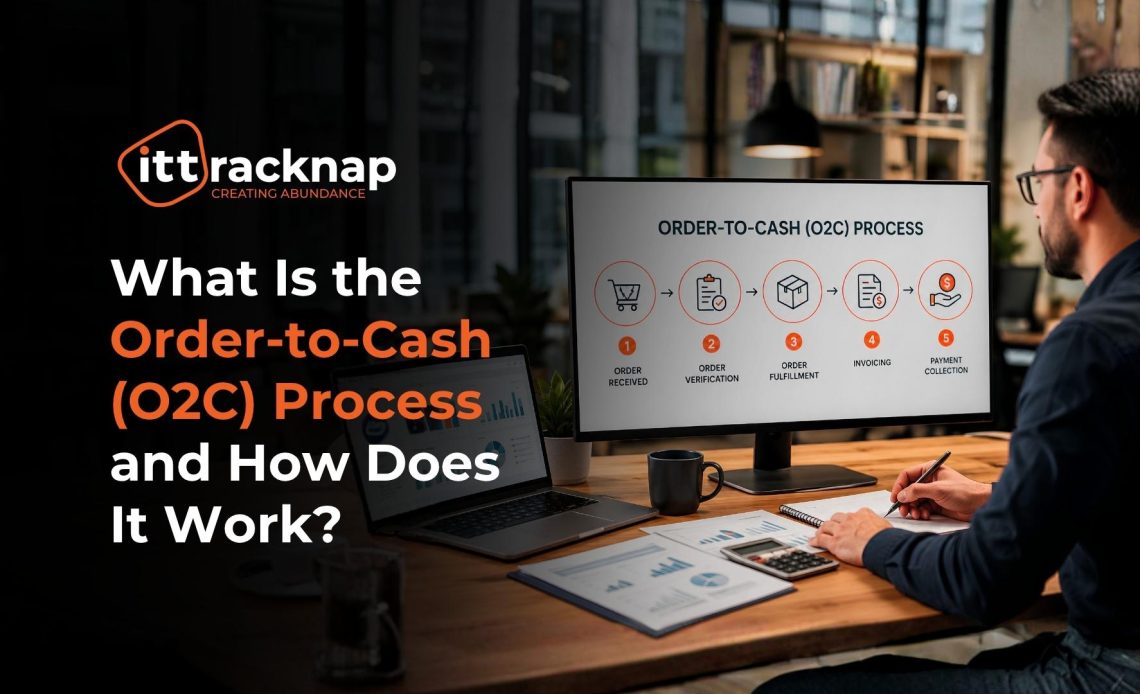
A customer places an order, the business fulfills it, an invoice is generated, and payment is collected. While this sounds straightforward, several teams and systems work behind the scenes to complete the journey.
This entire cycle is known as Order-to-Cash (O2C).
For businesses managing subscriptions, cloud services, digital products, or complex partner ecosystems, an efficient O2C cycle can improve cash flow, reduce operational effort, and create a better customer experience.
This guide explains the order-to-cash process, its key stages, common challenges, important KPIs, and how automation can help businesses build a faster and more reliable revenue cycle.
What Is the Order-to-Cash Process?
The order to cash process is the complete business cycle that starts when a customer places an order and ends when the business receives and records the payment.
The process typically covers order management, validation, fulfillment, invoicing, payment collection, accounts receivable, collections, and reconciliation.
A typical O2C process flow looks like this:
Order Placement → Order Validation → Fulfillment/Provisioning → Invoicing → Payment Collection → Collections → Reconciliation
The exact steps can differ by industry. However, the objective remains the same: convert customer orders into collected revenue accurately, efficiently, and with minimal friction.
For subscription and digital service businesses, the process can become more complex because orders may include recurring charges, usage-based pricing, upgrades, discounts, add-ons, and multiple services.
Why Is the Order-to-Cash Process Important?
O2C connects sales, operations, finance, and customer experience. A problem at one stage can create delays at another.
For example, incorrect order information can delay provisioning. A provisioning issue can result in an incorrect invoice, which may then delay payment.
That is why an effective order for cash management is about more than simply collecting money faster. Businesses need visibility and control across the entire revenue lifecycle.
Key benefits of an efficient O2C process include:
- Faster order processing
- Accurate billing and invoicing
- Quicker service provisioning
- Better cash flow visibility
- Reduced operational costs
- Fewer billing disputes
- Improved customer experience
APQC tracks metrics such as O2C cycle time, Days Sales Outstanding (DSO), on-time delivery, and perfect-order performance to help businesses benchmark their processes.
What Are the Steps in the Order-to-Cash Process?
The O2C cycle generally consists of seven key stages. Each stage contributes to the overall speed and accuracy of the revenue cycle.
1. Order Management
The process begins when a customer places an order. Orders may come through ecommerce platforms, sales teams, customer portals, marketplaces, APIs, or channel partners.
The order needs to be checked against the product catalog, customer information, pricing, availability, and contract terms.
For subscription businesses, an order could include recurring subscriptions, one-time charges, add-ons, discounts, or usage-based services.
Key objective: Capture accurate order information and prepare it for downstream processing.
2. Order and Credit Validation
Before fulfillment, businesses may need to validate the order and customer.
This can include:
- Customer information verification
- Credit-limit checks
- Payment-term validation
- Pricing and discount approval
- Contract validation
- Tax and billing information checks
Automating these checks can help identify exceptions early and prevent unnecessary delays.
Key objective: Approve valid orders while reducing financial and operational risk.
3. Fulfillment and Provisioning
Once an order is approved, the purchased product or service must be delivered. This can involve inventory allocation, picking, packing, and shipping for physical products.
For digital and subscription businesses, fulfillment may involve creating accounts, activating licenses, provisioning cloud resources, or enabling services.
For example, a customer purchasing cloud software should ideally have access to the service shortly after completing the order.
Key objective: Deliver the right product or service accurately and on time.
4. Invoicing
After fulfillment, the business generates an invoice based on the order and applicable billing rules.
An invoice may include:
- Products or services purchased
- Quantity or usage
- Pricing
- Discounts
- Taxes
- Payment terms
- Total amount due
Billing becomes more complicated for subscription businesses. Customers may upgrade, downgrade, add services, exceed usage limits, or receive prorated charges during a billing cycle.
An effective billing system needs to handle these changes accurately.
Key objective: Generate accurate and transparent invoices that customers can pay without unnecessary clarification.
5. Payment Collection
Once an invoice is issued, the business collects payments.
It depends on the business model; customers may pay through credit cards, bank transfers, direct debit, payment gateways, or other digital payment methods.
Automated payment reminders, recurring billing, and multiple payment options can make collections more efficient.
Key objective: Make payment simple while reducing delays and failed transactions.
6. Accounts Receivable and Collections
Not every customer pays immediately. The accounts receivable team tracks outstanding invoices and manages overdue payments.
Teams may monitor:
- Overdue invoices
- Payment history
- Customer disputes
- Outstanding balances
- Unapplied payments
- Collection activities
Businesses can prioritize collections based on invoice value, payment history, customer risk, and aging.
Key objective: Reduce outstanding receivables while maintaining positive customer relationships.
7. Payment Reconciliation and Reporting
The final stage involves matching received payments with customer accounts and invoices.
Reconciliation helps businesses determine:
- Which invoices have been paid
- Which balances remain outstanding
- Which payments are unmatched
- Which invoices are disputed
- Whether financial records are accurate
Once the information is reconciled, finance teams can use it to analyze revenue, collections, receivables, and customer payment behavior.
Key objective: Maintain accurate financial records and improve visibility into the revenue cycle.
Order-to-Cash for Subscription Businesses
Traditional businesses often manage O2C around individual transactions. Subscription businesses have different challenges.
A single customer can generate recurring transactions throughout the relationship. A customer might start with a basic subscription, add users, upgrade their plan, purchase an add-on, change usage, and renew automatically.
Each event can affect provisioning, billing, invoicing, and payment. This makes automation increasingly important for businesses operating recurring revenue models.
A subscription management platform such as RackNap can help connect subscription lifecycle management, provisioning, billing, marketplace operations, and partner management.
Traditional O2C vs. Automated O2C
Automation can transform O2C by connecting systems and reducing repetitive manual work.
| Area | Traditional O2C | Automated O2C |
| Order entry | Manual or fragmented | Centralized workflows |
| Validation | Manual checks | Rule-based validation |
| Provisioning | Manual activation | Automated provisioning |
| Billing | Manual or disconnected | Automated billing |
| Invoicing | Manual generation | Automated generation |
| Collections | Manual follow-up | Automated reminders |
| Reconciliation | Manual matching | Automated workflows |
| Reporting | Fragmented data | Centralized visibility |
| Scaling | Higher operational effort | More scalable |
The goal is not to remove people from the process. Instead, automation allows teams to focus on exceptions, customer issues, and strategic activities rather than repetitive administrative tasks.
What Is Order-to-Cash Process Automation?
Order to cash process automation uses software, integrations, and predefined workflows to automate repetitive activities across the revenue cycle.
For example, when a customer purchases a subscription, an automated workflow can:
- Validate the order.
- Create the subscription.
- Trigger service provisioning.
- Apply billing rules.
- Generate the invoice.
- Initiate payment collection.
- Update the customer account.
- Reconcile the transaction.
This creates a connected flow from the initial order to collect revenue.
Automation can also help businesses identify exceptions and route them to the right team instead of requiring employees to manually review every transaction.
Common O2C Challenges
Businesses often struggle with O2C because their systems and teams operate in silos.
Common challenges include:
-
Manual Data Entry
The process of moving information manually between CRM, ERP, billing, provisioning, and accounting systems increases the risk of errors and duplicate work.
-
Disconnected Systems
When sales, operations, and finance use separate systems without effective integration, employees may spend significant time transferring information between platforms.
-
Complex Billing
Recurring, usage-based, prepaid, postpaid, and hybrid billing models can make invoice generation difficult, especially when combined with discounts, taxes, currencies, and contract terms.
-
Slow Provisioning
Manual service activation creates a gap between purchase and service availability, which can negatively affect customer experience.
-
Payment Delays
Incorrect invoices, limited payment options, and inconsistent follow-ups can contribute to delayed collections.
How to Measure O2C Performance
Automation should be supported by clear performance metrics. Businesses can track KPIs such as:
| KPI | What It Measures |
| Order cycle time | Time required to process an order |
| Invoice accuracy | Percentage of invoices without errors |
| DSO | Average time required to collect receivables |
| Perfect order rate | Orders completed correctly without issues |
| Invoice-to-payment time | Time between invoicing and payment |
| Billing dispute rate | Frequency of invoice-related disputes |
| Cost per transaction | Cost of processing each transaction |
APQC’s benchmarking data reports a median total cost of $2.32 per $1,000 of revenue for performing O2C across its benchmarked organizations. This highlights why even modest efficiency improvements can have a meaningful financial impact on scale.
Real-World Examples of O2C Automation
RackNap customer stories demonstrate how connected billing, provisioning, marketplace, and partner operations can improve business performance.
1. Technova
Technova used ITTRackNap to automate operations across its distributor, channel partner, and end-customer ecosystem. The company reported a 35% increase in average revenue per partner after implementing ITTRackNap.
2. Reliance Infosystems
Reliance Infosystems implemented ITTRackNap to automate cloud billing and provisioning.The company reported a 40% reduction in operational costs, helping simplify its cloud service operations.
3. Xcell Host
Xcell Host used ITTRackNap to automate cloud and hosting service delivery across multiple providers. The company reported 12% cloud revenue growth after implementing the platform.
These examples demonstrate how O2C automation can extend beyond finance. Connecting ordering, provisioning, billing, and partner operations can improve both efficiency and revenue performance.
How to Improve Your O2C Process
Businesses can improve their O2C operations without necessarily replacing every existing system.
Start with these steps:
- Map the current process: Document every stage from order placement through payment reconciliation.
- Identify bottlenecks: Find where manual work, approvals, errors, or delays occur.
- Connect systems: Evaluate integrations between CRM, ERP, billing, payment, provisioning, and accounting platforms.
- Automate repetitive work: Prioritize high-volume activities such as provisioning, invoicing, payment reminders, and reconciliation.
- Create exception workflows: Allow routine transactions to move automatically while complex cases go to the appropriate team.
- Measure performance: Track cycle time, DSO, invoice accuracy, disputes, and operational costs.
This approach allows businesses to improve O2C progressively instead of attempting a complete transformation at once.
How RackNap Simplifies Complex Revenue Operations
For cloud, subscription, telecom, MSP, and technology businesses, managing O2C across disconnected systems can quickly become complex.
RackNap brings ordering, provisioning, subscription management, billing, partner operations, and customer management together on one platform.
With RackNap, businesses can:
- Manage products, services, and orders
- Automate subscription lifecycle management
- Streamline service provisioning
- Automate recurring and usage-based billing
- Simplify invoicing and payment workflows
- Manage partners and customer self-service
- Gain better visibility into revenue and operations
With these critical processes working together, RackNap reduces manual handoffs, improves operational visibility, and creates a more scalable revenue engine.
Conclusion
A well-managed O2C process can help businesses improve efficiency, accelerate collections, and deliver better customer experience. As products, subscriptions, and billing models become more complex, connected and automated workflows become increasingly important.
The right O2C strategy is not just about collecting payments faster. It is about creating a seamless journey from order to fulfillment to revenue.
Ready to simplify your O2C operations?
Explore RackNap to see how you can automate and connect your subscription, billing, provisioning, and partner operations on one platform.
