
The telecommunications industry powers the digital economy by enabling seamless communication, cloud connectivity, and real-time digital experiences. As technologies such as 5G, IoT, edge computing, and network automation gain momentum, telecom providers face new opportunities alongside growing operational challenges.
These shifts are reshaping how telecom companies improve efficiency, enhance customer experiences, and create new revenue streams. According to GSMA, mobile technologies and services contributed $7.6 trillion to the global economy in 2025, underscoring the industry’s expanding impact worldwide.
Several challenges and new trends in telecommunication are shaping up in the digital world, including:
Key Challenges
- Cybersecurity and network security risks
- Massive data growth
- Operational complexity
- 5G monetization pressure
- Customer experience expectations
Key Trends
- 5G Standalone and network slicing
- Edge computing
- Private 5G networks
- IoT expansion
- Network automation
These developments can help telecom providers make informed decisions and build sustainable growth strategies.
Before exploring the trends driving this transformation, let’s examine the biggest challenges telecom operators face today.
Top 5 Challenges in Telecommunication Industry
Despite continuous innovation and growing demand for connectivity, telecom providers operate in an increasingly complex business environment.
Intense competition, evolving regulations, expanding service portfolios, and rising infrastructure costs are pushing operators to rethink how they manage their networks and deliver value to customers.

At the same time, the shift toward digital services is creating new operational pressures that require greater agility, scalability, and efficiency. It is crucial for telecom companies that want to stay resilient, meet market demands, and position themselves for sustainable growth.
Let’s take a closer look at the top challenges shaping the telecommunications industry today.
1. Rise in Cybersecurity and Network Security Risks
Cybersecurity remains one of the most pressing concerns for telecom providers. Telecom networks serve as critical infrastructure, making them attractive targets for cybercriminals, ransomware groups, and nation-state attackers.
A successful attack can disrupt services, compromise customer data, damage brand reputation, and result in regulatory penalties.
Common security challenges include:
- Distributed Denial-of-Service (DDoS) attacks
- Data breaches
- Network vulnerabilities
- SIM swap fraud
- Insider threats
- Ransomware incidents
As networks become more interconnected through cloud platforms, APIs, 5G infrastructure, and IoT devices, telecom companies must adopt a proactive security strategy that combines monitoring, threat detection, and automated response mechanisms.
2. Massive Data Growth Management
Telecom providers manage unprecedented amounts of network traffic. Video streaming, cloud applications, connected devices, and enterprise workloads continue to drive exponential growth in data consumption.
This surge creates several operational challenges:
- Network congestion
- Increased infrastructure costs
- Storage requirements
- Capacity planning complexity
- Quality of service concerns
The rapid expansion of IoT further intensifies this challenge. GSMA Intelligence forecasts that global IoT connections will reach 38.7 billion by 2030, creating significant demands on telecom infrastructure.
Providers that leverage intelligent network management and scalable infrastructure will be better positioned to handle future demand.
3. Increase in Operational Complexity
Telecom businesses often manage multiple services, customer segments, pricing models, and partner ecosystems simultaneously.
Many providers support:
- Broadband services
- Mobile plans
- Managed services
- Cloud offerings
- IoT connectivity
- Enterprise networking solutions
Management across these services in different billing systems, customer portals, support channels, and operational processes often creates inefficiencies.
Without automation, telecom operators may struggle with:
- Service provisioning delays
- Billing errors
- Order management issues
- Customer support bottlenecks
- Revenue leakage
Providers worldwide have made operational simplification through integrated platforms a strategic priority.
4. Pressure to Monetize 5G Investments

Telecom companies have invested billions of dollars into building and expanding 5G infrastructure.
While network deployment continues to accelerate, generating sustainable returns remains a challenge. Many consumers view faster connectivity as a standard expectation rather than a premium service.
To maximize return on investment, providers must identify new business opportunities such as:
- Private 5G networks
- Network slicing services
- Smart city initiatives
- Industrial IoT deployments
- Enterprise connectivity solutions
- Edge computing services
According to Ericsson, 5G subscriptions exceeded 3 billion globally, and the technology is expected to become the dominant mobile access technology in the coming years.
The challenge is no longer deploying 5G. The challenge is monetizing it effectively.
5. Deliver Superior Customer Experiences
Customer expectations continue to evolve. Modern consumers expect fast onboarding, self-service capabilities, transparent pricing, personalized offers, and instant support.
Even minor service disruptions can lead to customer dissatisfaction and increased churn.
Key factors affecting customer experience include:
- Service reliability
- Billing accuracy
- Resolution speed
- Omnichannel support
- Personalized recommendations
- Account transparency
Providers that prioritize customer-centric experiences are more likely to improve retention and strengthen long-term customer relationships.
Top 5 Trends Shaping the Telecommunications Industry
The current trends in telecommunications are creating new opportunities for growth while helping providers address the challenges discussed above.
1. 5G Standalone Networks and Network Slicing
The telecom industry has moved beyond basic 5G deployment. The current focus centers on 5G Standalone (5G SA) architectures that unlock advanced capabilities such as network slicing.
Network slicing allows providers to create dedicated virtual networks tailored to specific applications and industries.
Examples include:
- Smart manufacturing
- Healthcare services
- Autonomous transportation
- Public safety communications
The GSMA report stated that 80% of global mobile connections are expected to be 5G by 2030, reflecting continued industry momentum.
This evolution enables telecom operators to move beyond connectivity and deliver specialized, value-added services.
2. Edge Computing and Low-Latency Services
Many modern applications require real-time data processing. Traditional cloud environments often introduce latency that limits performance.
Edge computing addresses this challenge by processing data closer to users and devices.
Benefits include:
- Lower latency
- Faster response times
- Reduced bandwidth consumption
- Enhanced application performance
Industries such as manufacturing, healthcare, logistics, and gaming increasingly rely on edge computing to support mission-critical operations.
As edge infrastructure expands, telecom providers gain new opportunities to deliver premium services and enterprise solutions.
3. Private 5G Networks for Enterprises
Private 5G networks have emerged as a significant growth area for telecom providers.
Unlike public networks, private deployments offer businesses greater control, security, and performance customization.
Organizations use private 5G networks for:
- Factory automation
- Warehouse management
- Mining operations
- Oil and gas facilities
- Smart campuses
These deployments help enterprises improve efficiency while creating additional revenue streams for telecom operators.
4. IoT Expansion Across Industries
IoT adoption continues to accelerate across nearly every industry.
Connected sensors, smart devices, and machine-to-machine communication enable organizations to collect real-time data and improve operational visibility.
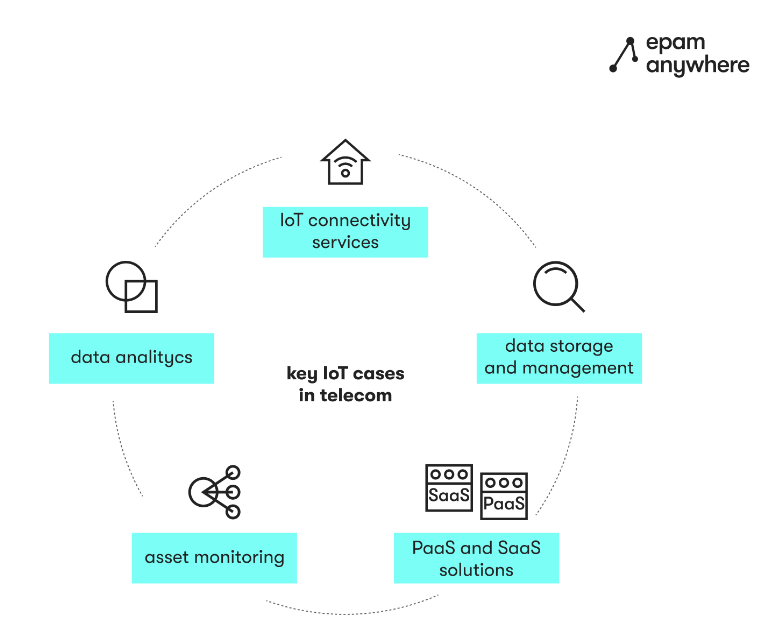
Popular IoT applications include:
- Smart cities
- Fleet management
- Predictive maintenance
- Connected healthcare
- Smart energy management
- Asset tracking
The growing number of connected devices creates substantial opportunities for telecom providers to offer connectivity, analytics, security, and managed services.
5. Network Automation and Intelligent Operations
Modern telecom networks generate enormous volumes of operational data. Manual management is no longer practical at scale.
Network automation helps providers:
- Reduce operational costs
- Improve service reliability
- Detect faults faster
- Optimize resource allocation
- Improve customer experiences
Advanced analytics also support predictive maintenance by identifying potential issues before they impact customers.
How Telecom Providers Can Turn Challenges into Growth Opportunities
Industry challenges do not necessarily limit growth. In many cases, they create opportunities for innovation and differentiation.
Telecom providers can strengthen their competitive position by focusing on:
- Automate Core Operations: Automation reduces manual workloads, improves accuracy, and accelerates service delivery.
- Simplify Customer Management: Unified customer management platforms help providers deliver better service experiences while reducing administrative overhead.
- Build Scalable Infrastructure: Cloud-ready systems and flexible architectures enable providers to support future expansion without significantly increasing complexity.
- Develop New Revenue Streams: Value-added services such as private networks, IoT solutions, managed services, and edge computing help diversify revenue sources.
How ITTRackNap Helps Telecom Providers Scale Operations
As telecom businesses expand their service portfolios, managing billing, provisioning, subscriptions, customer onboarding, and partner ecosystems becomes increasingly challenging.
Our product RackNap helps telecom providers streamline these processes through a centralized platform designed for subscription management, service automation, billing, and customer lifecycle management.
With automated workflows and self-service capabilities, providers can reduce operational complexity, improve customer experiences, and accelerate time-to-market for new services.
Conclusion
The telecommunications industry continues to evolve rapidly. Cybersecurity concerns, data growth, operational complexity, 5G monetization, and customer expectations remain significant challenges. At the same time, technologies such as 5G Standalone, edge computing, private networks, IoT, and network automation are creating new opportunities for innovation and growth.
Success will depend on a provider’s ability to balance operational efficiency with service innovation. Organizations that modernize their processes, automate key operations, and build scalable service delivery models will be better positioned to compete in an increasingly connected world.
For telecom providers looking to simplify operations while supporting new digital services, solutions that combine automation, subscription management, billing, and customer lifecycle management can play an important role in achieving sustainable growth.

A very informative article, learned a lot from this, thanks a lot for sharing this with us. Nice blog.
HI, Thanks for your information, it’s really helpful for me. I am waiting for your next blog
Thank you for this information, I appreciate your effort, please keep us update.
Hey! Thanks a lot for a good article about telecommunication. It’s so very interesting.
Thank you for this information, please keep us update.
Thank you for this information.
Thank you for this information.
Thank you for this nice blog about Telecommunications. I appreciate your effort, please keep posting
nice blog
Thanks for your article, I would like you to write on what will be the new normal in the pandemic situation in telecom industry…
Awesome Post. Please include content on wireless challenges faced in today’s world post covid pandemic hit badly.
cool stuff you have and you keep overhaul every one of us
Great article. Thanks for sharing the informative article.
Thank you for sharing. Do you think AI going to replace most of job openings in telecom industry?
Hi there! thanks for sharing the information it’s really helpful
Great Post! Thanks for sharing.
Awesome! Information. Great work thank you for sharing such useful information. keep it up all the best.
Useful Post. Great work thank you for sharing such useful information’s.
Useful Post. Keep it up all the best.
This is so well written and so wonderful. Thank you so much for this! Look forward to more of your articles.
Thank you for sharing this wonderful blog !! I too feel that 5G is a big step in the telecom sector and it will lead to many new challenges as well as benefits for the common people.
This was a very meaningful post, so informative and encouraging information, Thank you for this post.
Great work thank you for sharing such useful information’s. keep it up all the best. I can also refer you to one of the best Telecom and technology solutions services in Hyderabad.
I love reading an article that will make people think.
Also, thanks for permitting me to comment!
I really like this blog. It is really informative and useful for me. Thumbs up.!!
Precisely what I was looking for, thanks for putting
up.
Great article!
Quality articles or reviews is the important to attract the people to visit the site, that’s what this website is providing.
Thanks for a marvelous posting! I truly enjoyed reading it,
you will be a great author.I will make sure to bookmark your blog and will eventually come back in the future.
I want to encourage you to ultimately continue your great job,
have a nice morning!
Spot on with this write-up, I actually think this web site needs a lot more attention. I’ll probably be returning to read through more, thanks for the information!
Your style is unique compared to other people
I have read stuff from. Thanks for posting when you have the opportunity,
Guess I’ll just bookmark this page.
Awesome! Its really amazing post, I have got much clear idea regarding from this piece of writing.
Nice post. I was checking continuously this blog and I am inspired!
Extremely useful info particularly the remaining phase 🙂 I deal with such info much.
I was looking for this certain information for a long time.
Thank you and good luck.
Good article. I will be facing a few of these issues as well..
Pleasant article. I was checking constantly this web site and i am impressed! Extremely helpful records especially the very last role we worry when it comes to these types of records a lot.
Hey, I think your site might be having browser compatibility issues. When I look at your website in Firefox, it looks fine but when opening in Internet Explorer, it has some overlapping. I just wanted to give you a quick heads up! Other then that, awesome blog!|
I’ve been browsing on-line more than three hours today, but I never discovered any fascinating article like
yours. It’s beautiful price enough for me. Personally, if
all site owners and bloggers made good content material
as you probably did, the web will probably be much more useful than ever before.
Pretty great post. I just stumbled upon your blog and wished to mention that I’ve truly enjoyed surfing around your weblog posts.
After all I will be subscribing to your rss feed and I am hoping you write again very soon!
Hey I am so grateful I found your website,
I really found you by error, while I was searching on Yahoo
for something else, Nonetheless I am here now and would just like to say
thanks for a marvelous post and a all round thrilling
blog (I also love the theme/design), I dont have time to read it all at the moment but I have book-marked it and also added in your RSS feeds,
so when I have time I will be back to read more, Please do keep up the superb work.
Good Ьⅼog you have here..It’s difficult to find higһ
qualіty writing like yours nowaɗays. I serioսsly apprecіate individuals like you!
Τakke care!!
As we all know, technology grows so fast that there are always new inventions that create better services and better products. I like that you discuss the importance of telecommunications in the industry. Telecommunication would be one of the most critical technology in having all sector grows. With different providers continually evolving, looking for ways to develop and enhance communication is beneficial.
As we all know, technology grows so fast that there are always new inventions that create better services and better products. I like that you discuss the importance of telecommunications in the industry. Telecommunication would be one of the most critical technology in having all sector grows. Telecom companies should take a more informed approach to simplification of business processes which can help them ride the digital transformation wave.
Hi, thanks for the amazing article. I believe that excessive telecom equipment is going to be one of the challenges faced by the telecommunication industry. And taking about the trends then there would be less demand for traditional services.
I’d like to find out more? I’d want to find out some additional
information.
There is obviously a bundle to know about this. I believe you made various good points in features also.
As a Newbie, I am constantly browsing online for articles that can help me.
Thank you
The information shared is extremely helpful! Thank you for sharing!
Great blog and thanks for sharing.
So much in just one page. Nice article.