
Cloud adoption continues to accelerate as businesses move more workloads to the cloud. As organizations scale their cloud environments, many are also investing in cloud management and automation strategies to improve efficiency and control costs.
Flexera’s 2025 State of the Cloud Report says that 84% of organizations cite managing cloud spend as their top challenge, while cloud spending is expected to grow by 28% in the coming year. As cloud environments become more complex, service providers need efficient ways to deploy, manage, and scale infrastructure without increasing operational overhead.
Manual infrastructure deployment can limit scalability and increase administrative effort. This is why automation has become a key requirement for cloud service providers.
In this blog, we’ll explore what AWS cloud provisioning means and how Plesk supports automated cloud delivery. We’ll also examine how automation platforms such as RackNap help providers simplify service deployment, management, and billing.
What is AWS?
Amazon Web Services (AWS) is the world’s leading cloud computing platform. It offers more than 200 cloud services that help businesses build, deploy, and manage applications without maintaining physical infrastructure.
AWS provides computing, storage, networking, databases, analytics, artificial intelligence, security, and monitoring services across global regions.
The wide range of AWS cloud products allows organizations to build flexible and scalable environments for different workloads. Businesses can start small and scale resources as demand grows.
One of the biggest advantages of the AWS cloud platform is its pay-as-you-go pricing model. Organizations only pay for the resources they consume, helping optimize infrastructure costs.
Key Benefits of AWS includes:
- Global infrastructure coverage
- Elastic scalability
- High availability
- Pay-as-you-go pricing
- Enterprise-grade security
- Broad service ecosystem
What Is Plesk?
Plesk is a modern server and website management platform that helps hosting providers, developers, agencies, and IT teams manage cloud infrastructure through a centralized interface. It simplifies server administration, website deployment, security management, backups, and application hosting.
Today, Plesk supports technologies such as WordPress, Docker, Git, Node.js, PHP, Python, Laravel, and various web application stacks. It also offers built-in security tools, backup capabilities, SSL management, and automation features.
When combined with AWS, Plesk helps service providers simplify cloud operations and improve service delivery.
Key Features of Plesk includes:
- Server management
- Website management
- Security and SSL
- Backup and recovery
- Multi-tenant hosting support
AWS and Cloud Automation Market Trends
Cloud automation has become a priority for organizations managing growing cloud environments.
Recent industry studies show:
- AWS continues to hold approximately 29–30% of the global cloud infrastructure market.
- Global cloud infrastructure spending exceeded $100 billion per quarter during 2025.
- 84% of organizations identify cloud cost management as a major challenge.
- Cloud spending is expected to increase by 28% year over year.
- Around 70% of organizations now operate hybrid or multi-cloud environments.
- These trends highlight the growing need for automated cloud provisioning and management solutions.
Sources: Synergy, Flexera, and SoftwareOne
What Is AWS Cloud Provisioning?
AWS cloud provisioning is the process of allocating and configuring cloud resources automatically or manually within AWS environments.
These resources may include:
- Amazon EC2 instances
- Virtual networks
- Storage services
- Databases
- Security configurations
- Monitor tools
Modern AWS cloud provisioning uses predefined templates, policies, and workflows to deploy resources consistently and quickly.
Instead of manually configuring every component, businesses can automate deployments through APIs and orchestration tools. This reduces deployment time, minimizes human errors, and improves operational efficiency.
Why Cloud Automation Matters Today
Cloud services have become increasingly complex. Service providers often manage hundreds or thousands of customers across multiple environments. Manual provisioning creates operational bottlenecks and increases the chances of configuration errors.
A modern cloud automation platform helps organizations automate:
- Infrastructure deployment
- Service activation
- User provisioning
- Billing processes
- Monitoring workflows
- Resource lifecycle management
AWS itself supports automation through services such as CloudFormation and Systems Manager, enabling Infrastructure as Code (IaC) and standardized deployments.
Automation allows businesses to improve delivery speed while maintaining consistency across environments.
How AWS Cloud Provisioning Works with Plesk
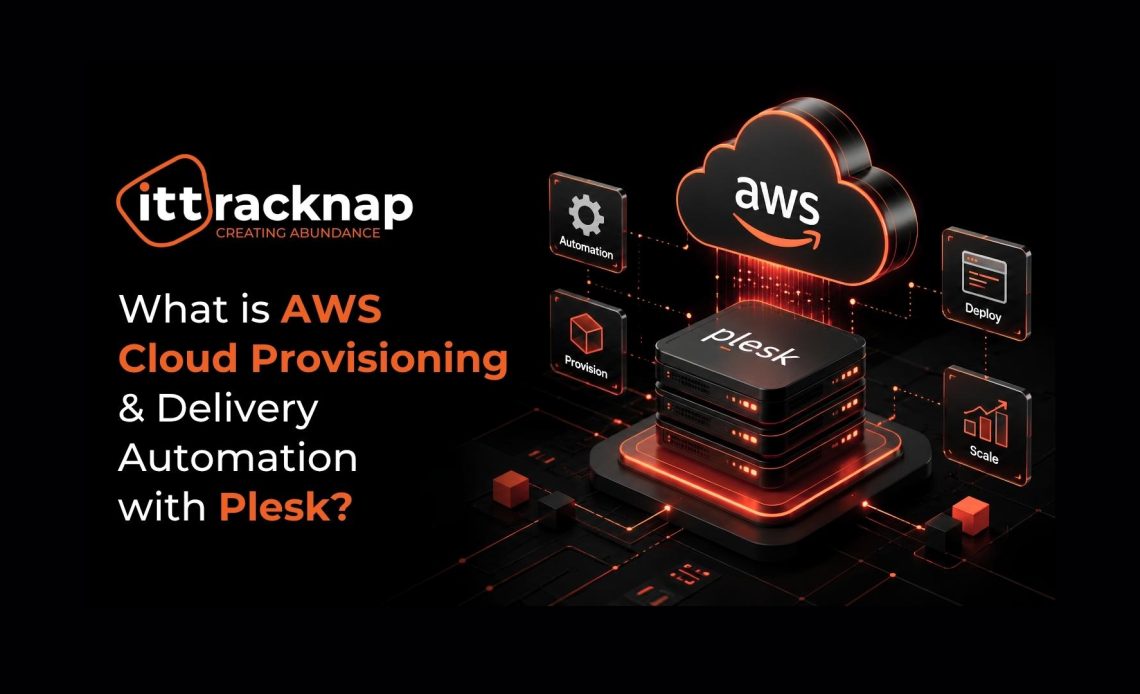
Plesk streamlines AWS cloud provisioning by automating infrastructure deployment and simplifying ongoing service management. The process typically includes server creation, platform deployment, and centralized administration.
Automated Server Deployment
When a customer purchases a hosting or cloud service, the provisioning workflow automatically creates the required AWS resources.
Server configurations, networking settings, and security policies are applied according to predefined templates.
Automated Plesk Deployment
After the infrastructure becomes available, Plesk can be deployed automatically. The system configures user access, management settings, and required services without manual intervention.
Simplified Service Management
Plesk allows customers to manage websites, applications, domains, databases, email accounts, and backups from a single dashboard.
This centralized management model reduces administrative effort and improves user experience.
RackNap Automates AWS Cloud Provisioning and Delivery
RackNap helps cloud service providers automate the complete lifecycle of cloud service delivery.
As a comprehensive cloud automation platform, RackNap integrates with AWS environments to automate provisioning, customer onboarding, billing, and service management.
Automated Service Provisioning
Once a customer places an order, RackNap can automatically initiate resource creation and service deployment.
This reduces manual work and speeds up service activation.
Automated Billing Management
Cloud businesses often support both prepaid and postpaid billing models. RackNap helps automate:
- Usage tracking
- Invoice generation
- Payment management
- Subscription management
Lifecycle Automation
The platform can automate service upgrades, renewals, suspensions, and cancellations based on predefined business rules.
Centralized Administration
Service providers gain visibility into infrastructure resources, customer subscriptions, billing operations, and service statuses from a single dashboard.
Benefits of Automated Cloud Provisioning
AWS cloud provisioning automation helps service providers simplify infrastructure management while improving service delivery. Automation of repetitive provisioning and operational tasks helps businesses reduce manual effort, improve consistency, and scale services more efficiently.
The following benefits highlight why automated provisioning has become a key component of modern cloud operations:
- Faster Service Delivery: Automation reduces provisioning time from hours to minutes.
- Improved Operational Efficiency: Teams spend less time on repetitive administrative tasks.
- Better Accuracy: Automated workflows reduce human errors and configuration issues.
- Scalability: Providers can support business growth without increasing operational complexity.
- Better Customer Experience: Customers receive faster access to services and improved self-service capabilities.
- Cost Optimization: Automation helps improve resource utilization and operational efficiency.
Conclusion
Cloud service providers need faster and more efficient ways to deploy and manage infrastructure. Manual processes can no longer keep pace with growing customer expectations and increasingly complex cloud environments.
The combination of AWS, Plesk, and automation platforms such as RackNap helps providers simplify infrastructure deployment, automate billing and lifecycle management, and improve operational efficiency.
Effective AWS cloud provisioning enables organizations to deliver reliable services while maintaining control over costs and resources.
As adoption of AWS cloud services, AWS cloud products, and AWS infrastructure services continues to grow, automation will remain a critical factor in building scalable and competitive cloud businesses.
Ready to automate AWS cloud provisioning and simplify service delivery? Book a demo with RackNap to see how automated provisioning, billing, and lifecycle management can help scale your cloud business.
This info is invaluable. Where can I find out more?
Hi There,
You can find more here- https://www.racknap.com/amazon-web-services-aws-cloud-automation/
Nice blog| I have gained good knowledge about AWS. Thanks for sharing such valuable information.
Nice information posting.
great blog article.
Good content.A very informative blog.thanks for sharing
Good content and very informative blog.
Developers nowadays have to build a proper understanding of data analysis tools to get a job in an organization.
Hurrah! At last I got a blog from where I know how to truly obtain helpful information concerning my study and knowledge.
The article posted was very informative and useful. You people are doing a great job. Keep going.