
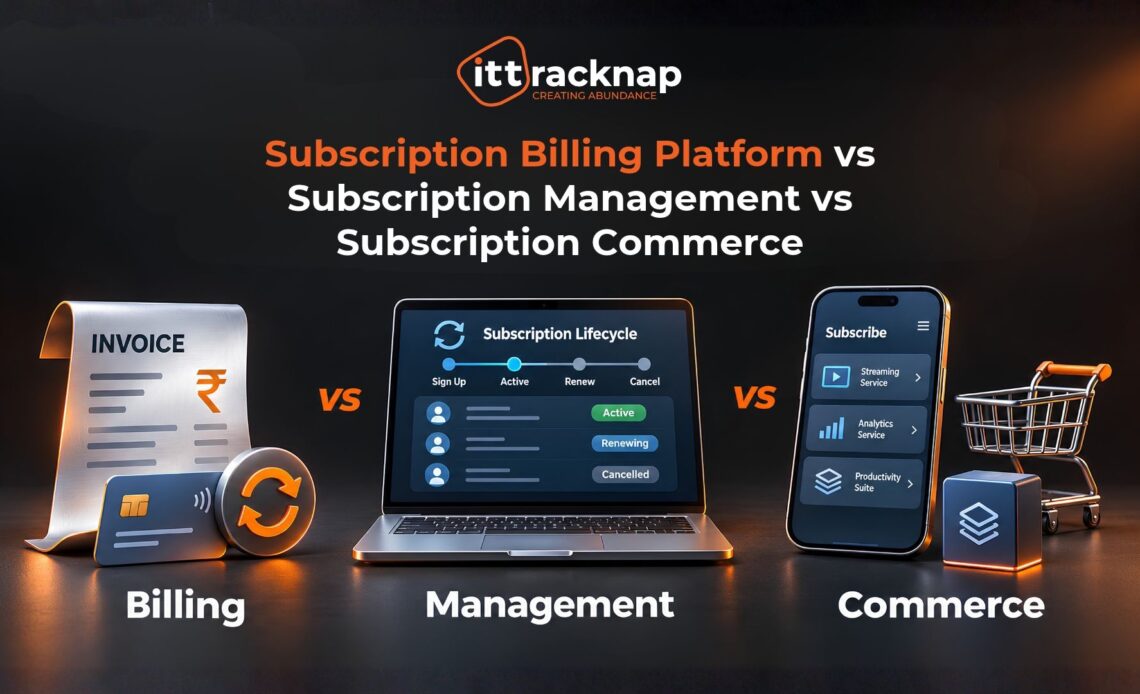
Quick Answer: The difference between the three is scope, not quality:
- Subscription billing software calculates charges, sends invoices, and collects recurring payments from customers.
- Subscription management controls each subscription’s lifecycle, from provisioning and plan changes to renewal and cancellation.
- Subscription commerce covers the full customer journey, from product discovery and ordering to provisioning and billing.
In short, subscription management includes billing, and subscription commerce includes both of them in one connected system.
Managed service providers (MSPs) and Microsoft Cloud Solution Provider (CSP) partners now sell seats, licenses, and usage every month. Yet vendors label their tools as subscription billing, subscription management, or subscription commerce, often for similar products.
These labels matter because each category solves a different operational problem. Choose the wrong one, and gaps appear between what customers order, what vendors provision, and what finance invoices. That is why connected subscription billing and pricing management has become central to how cloud providers protect their margins.
The sections below explain each category, compare them side by side, and help you choose the right one.
What Is Subscription Billing Software?
Subscription billing software is the system that turns an active subscription into collected revenue. It applies the price, billing frequency, and any discounts to each subscription on your books. It then generates the invoice, calculates the right tax, and records every payment against the customer account.
Its core functions typically include the following:
-
Price Calculation:
The system applies flat-rate, per-seat, tiered, or usage-based pricing to each active subscription.
-
Invoices:
The system sends recurring invoices on the correct cycle, including prorated charges for mid-cycle changes.
-
Usage Capture:
Consumption data, such as Azure usage or backup storage, becomes billable line items on the invoice.
-
Payments and Collections:
The platform records incoming payments, sends reminders, and flags overdue accounts for follow-up.
For a cloud service provider, billing is rarely as simple as sending the same invoice each month. A single customer might hold annual Microsoft 365 seats, monthly backup licenses, and pay-as-you-go Azure consumption.
Each of these services has its own cost basis from a vendor or distributor. The billing engine has to reconcile what the provider is charged with what it charges customers, or margin slips away unnoticed.
RackNap’s billing and invoicing module addresses this problem for cloud providers. It supports recurring and usage-based billing, automated invoicing, and real-time revenue reporting from one engine.
A standalone billing tool, however, assumes the subscription already exists with the vendor. The creation, change, and cancellation of that subscription belong to subscription management.
What Is Subscription Management, and How Does It Differ from Billing?
Subscription management controls the life of each subscription, from activation through to cancellation. The billing question is, “How much does this customer owe?” The management question is, “What does this customer have now, and what will change next?”
A subscription management platform usually handles these tasks:
1. Service Activation
The vendor activates the service as soon as an order is approved in the system.
2. Changes
The platform processes upgrades, downgrades, seat additions and reductions, add-ons, and plan switches.
3. Renewals
Auto-renewals, renewal reminders, and term changes are applied on schedule without manual tracking.
4. Suspensions and Cancellations
Services are paused or ended in line with vendor rules and contract terms.
5. Entitlement Records
A single view shows which customer holds which licenses, and on which terms.
This layer matters most when vendor rules are strict, as they are with Microsoft. Under the new commerce experience (NCE), partners can cancel or reduce license-based subscriptions for a prorated refund only within seven days of purchase or renewal.
They can also schedule changes so that they take effect at the end of the current term. A subscription management tool helps a CSP partner apply these rules consistently across many customers, instead of tracking deadlines in spreadsheets.
In practice, subscription management and billing must share the same data to stay accurate. Every seat change alters the next invoice, and every missed cancellation turns into a disputed charge.
That is why RackNap combines subscription lifecycle management and billing in one system, so a change in one place shows up in the other.
What Is a Subscription Commerce Platform?
A subscription commerce platform covers the full journey, from a customer discovering a product to paying for it every month. It adds a selling layer on top of subscription management and billing.
That layer includes a product catalog, a digital storefront, online ordering, and customer self-service.
For cloud businesses, the commerce layer typically includes these capabilities:
-
Product Catalog
Cloud and non-cloud offers from several vendors sit together, each with its own pricing and margin rules.
-
Branded Storefront or Marketplace
Customers and resellers browse and order services without emailing your sales team.
-
Self-service Portal
Customers view their subscriptions, add seats, download invoices, and raise requests on their own.
-
Partner and Reseller Tiers
Distributors and MSPs can give resellers their own storefronts, price lists, and customer bases.
-
Automated Order-to-cash Flow
An approved order triggers provisioning and starts billing without anyone re-keying data.
The real value of subscription commerce is the connection between these steps. With one shared record, a customer who adds ten Microsoft 365 seats at midnight sees them activated and correctly charged by morning.
How Do the Three Categories Compare?
Vendors use these terms loosely, so the table below compares the three categories by the problem each one solves.
| Criteria | Subscription Billing Software | Subscription Management | Subscription Commerce Platform |
| Core question | How much does the customer owe? | What does the customer have, and what changes next? | How does the customer find, buy, use, and pay for services? |
| Main users | Finance and accounts teams | Operations and service delivery teams | Sales, operations, finance, partners, and customers |
| Typical functions | Pricing, invoicing, tax, usage rating, payments, revenue reports | Provisioning, upgrades, downgrades, renewals, suspensions, entitlements | Catalog, storefront, self-service, reseller tiers, plus management and billing |
| Starts working at | An active subscription | An approved order | Product discovery |
| Common gap if used alone | Relies on manual updates when subscriptions change | Needs a separate tool to invoice and collect | Fewer gaps, but a larger implementation effort |
| Typical fit | Providers with few vendors and stable plans | Providers with frequent seat and plan changes | Distributors, MSPs, and CSPs selling multi-vendor catalogs at scale |
The three categories are cumulative rather than competing, since each one builds on the layer below it.
Which Subscription Platform Does Your Cloud Business Need?
The right platform depends on where your operational pain sits today and where your business is heading. These five factors usually settle the choice:
1. Number of vendors:
One or two vendors can be managed with billing software and vendor portals, but several vendors push you toward a unified platform.
2. Frequency of change:
Frequent seat changes, monthly terms, and usage-based services make disconnected billing tools error-prone.
3. Self-service expectations:
If customers expect to order and manage services themselves, you need a commerce layer with a storefront and portal.
4. Reseller sales:
If you sell through resellers or sub-partners, you need multi-tier pricing, partner storefronts, and partner-level invoicing.
5. Reconciliation gaps:
If your team compares vendor invoices against customer invoices by hand, the gap sits between management and billing.
Which Platform Fits Your Business? 3 Example Scenarios
The three illustrative scenarios below show how these factors translate into a choice.
-
Small MSP with a focused portfolio:
An MSP resells Microsoft 365 to 40 small businesses on annual terms, and seat counts change a few times a month. Subscription billing software, combined with Microsoft Partner Center, may be enough for this business for now.
-
Expanding Microsoft CSP partner:
A CSP partner sells Microsoft 365, Azure, and a third-party backup service on mixed monthly and annual terms. Renewal dates, prorated changes, and Azure consumption make spreadsheets risky at this stage. A subscription management platform with integrated billing helps the team track terms and invoice accurately from the same data.
-
Distributor or hosting provider with resellers:
A distributor offers hundreds of cloud and hosting products to a network of resellers, each with its own margins and end customers. A subscription commerce platform is the natural fit for this business model. The distributor needs storefronts, partner pricing, automated provisioning, and multi-level invoicing to work together.
Where Does RackNap Fit?
RackNap is a subscription commerce platform for cloud and technology providers, so it spans all three categories rather than billing alone. It supports recurring, usage-based, and hybrid pricing with automated invoicing, auto-renewal, and lifecycle management for every subscription.
Its branded marketplaces, integrated catalogs, and self-service portal connect to automated provisioning and multi-tier partner management. RackNap also integrates with Microsoft 365, Microsoft Azure, Amazon Web Services (AWS), Google Workspace, and Acronis.
For Microsoft partners, RackNap supports Microsoft CSP operations management for both direct and indirect CSP businesses. RackNap connects the order-to-cash chain without replacing your accounting or professional services automation (PSA) tools.
Frequently Asked Questions
1. Is subscription billing software the same as recurring billing software?
The two terms are often used interchangeably, since both automate repeat invoicing and payment collection. Subscription billing software usually goes further, with plan-based pricing, proration, and usage charges tied to each subscription.
2. Does a subscription commerce platform include billing?
In most cases, yes, because a subscription commerce platform builds on subscription management and billing. It then adds the product catalog, storefront, and self-service layer, though the exact scope varies by vendor.
3. What is a subscription service platform?
A subscription service platform is a general term for software that sells, manages, or bills for subscription services. Its meaning varies by vendor, so it may refer to billing software, a management tool, or a full commerce platform.
4. Do Microsoft CSP partners need a separate subscription platform?
Microsoft Partner Center lets partners buy and manage Microsoft subscriptions, but it does not bill their end customers. Partners still need their own process to price, invoice, and support customers. A subscription platform automates customer-facing ordering, provisioning, and invoicing on top of Partner Center.
5. When should an MSP move from billing software to a commerce platform?
Common triggers include adding new vendors, selling through resellers, and offering self-service ordering to customers. Another strong sign is when your team spends hours each month reconciling vendor and customer invoices by hand.
Conclusion: Choose by Where the Chain Breaks
The real decision is how much of the order-to-cash chain you want connected in one system. For stable, single-vendor portfolios with few changes each month, subscription billing software is usually enough. Once seat changes, renewals, and vendor terms start to multiply, subscription management becomes essential. A subscription commerce platform makes the most sense when you sell multi-vendor catalogs, work with resellers, or let customers buy and manage services themselves.
Before you shortlist vendors, map where your team re-keys data between orders, provisioning, invoicing, and vendor bills. If those handoffs point to the full chain, evaluate RackNap for its combined marketplace, provisioning, billing, and partner management.
Book a RackNap demo to see subscription commerce in action.
