
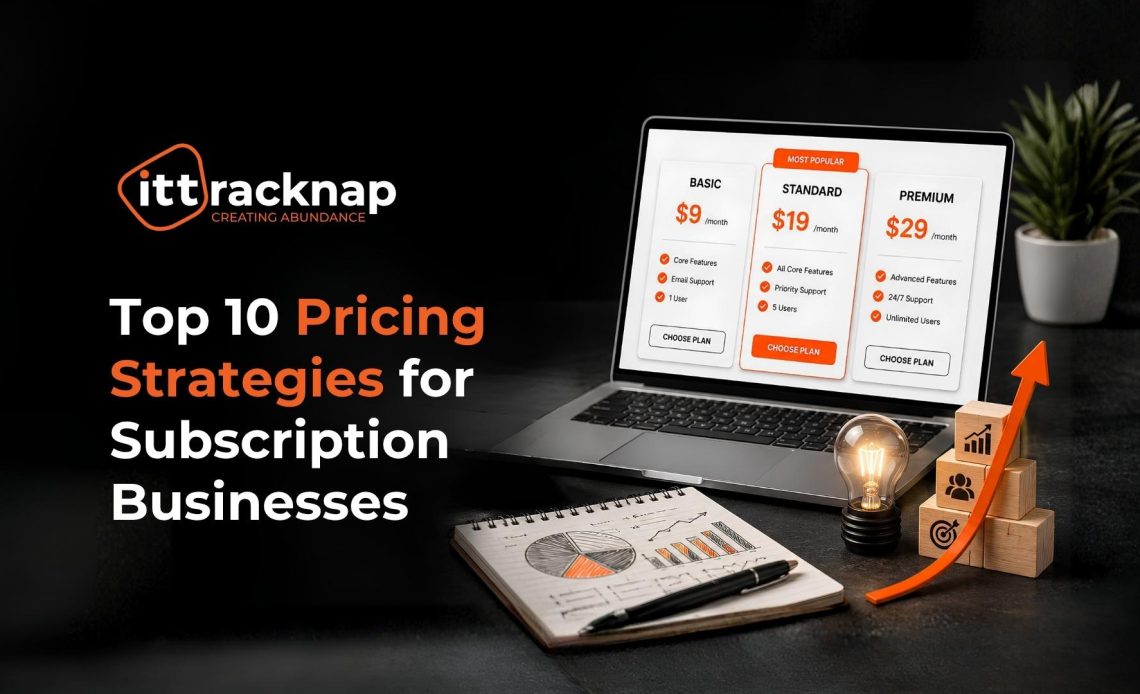
Subscription-based business models continue to grow across SaaS, telecom, streaming, AI, fintech, and eCommerce.
According to the Zuora Subscription Economy Index, subscription businesses continue to outperform traditional business models. This highlights the growing importance of recurring revenue and flexible pricing strategies.
Pricing is no longer just about setting a monthly fee. The right pricing strategy can improve customer acquisition, increase retention, and drive long-term revenue growth.
The most popular pricing strategies for subscription businesses include:
- Value-Based Pricing
- Tiered Subscription Pricing
- Usage-Based Pricing
- Freemium with Premium Upgrades
- Hybrid Pricing Models
- Annual Subscription Discounts
- Psychological Pricing
- Competitive Pricing
- Dynamic Pricing
- Outcome-Based Pricing
This guide explores the top 10 pricing strategies for subscription businesses in 2026. It also covers practical examples and best practices to help maximize recurring revenue.
What Is a Pricing Strategy?
A pricing strategy is the structured approach businesses use to determine product or service pricing while balancing customer value, competition, business goals, and operating costs.
The right pricing strategy helps businesses attract customers, remain competitive, improve profitability, and maximize recurring revenue. For subscription businesses, pricing also plays a critical role in customer acquisition, retention, and long-term growth.
A Detailed List of the Top 10 Pricing Strategies for Subscription Businesses
No single pricing model works for every business. The right approach depends on your target audience, product offering, and revenue goals.
The following pricing strategies can help subscription businesses attract customers, increase retention, and maximize recurring revenue.
1. Value-Based Pricing
Among all pricing strategies, value-based pricing remains the most effective for subscription businesses. Instead of calculating prices based only on costs, companies charge according to the value customers receive.
For SaaS products, this could mean pricing based on time saved, revenue generated, or productivity improvements.
Why it works
- Aligns pricing with customer outcomes
- Supports higher profit margins
- Reduces price sensitivity
Pricing strategy example
CRM software that helps sales teams close more deals can justify premium pricing because customers see measurable business results.
2. Tiered Subscription Pricing
Tiered pricing continues to dominate the subscription economy because it serves different customer segments with different needs.
A typical pricing structure includes:
- Basic Plan
- Professional Plan
- Enterprise Plan
Each tier offers increasing features, support, and usage limits.
Benefits
- Attracts startups and enterprises alike
- Encourages natural upgrades
- Improves customer lifetime value
Many leading SaaS platforms such as HubSpot, Notion, and Canva successfully use this tiered pricing model.
3. Usage-Based Pricing
Usage-based pricing charges customers only for what they consume. Instead of paying a flat monthly fee, users pay based on API calls, storage, transactions, or active users.
This model has become increasingly popular with AI and cloud platforms.
Advantages
- Lower entry barrier
- Fair pricing for customers
- Revenue scales with customer growth
Usage-based pricing works particularly well for cloud infrastructure, AI platforms, communication APIs, and developer tools.
4. Freemium with Premium Upgrades
Freemium continues to be one of the important pricing strategies for acquiring users at a scale.
Businesses provide a free version with limited functionality while reserving advanced features for paid subscribers.
Best practices
- Offer enough value to build trust
- Make premium benefits obvious
- Keep upgrade paths simple
This approach is especially effective for collaboration software, productivity tools, and communication platforms.
5. Hybrid Pricing Models
One of the fastest-growing types of pricing strategies in 2026 is hybrid pricing. Instead of relying on one pricing method, companies combine multiple approaches.
Common combinations include:
- Monthly subscription + usage fees
- Base plan + add-ons
- Tiered plans + consumption pricing
Hybrid pricing gives businesses greater flexibility while allowing customers to pay only for additional usage when required. Industry analysts report increasing adoption of hybrid pricing among AI-native SaaS companies.
6. Annual Subscription Discounts
Many subscription companies encourage annual billing by offering discounts compared to monthly plans.
For example:
- Monthly Plan: $29/month
- Annual Plan: $290/year
Customers receive savings, while businesses gain predictable cash flow and lower churn.
Key benefits
- Higher upfront revenue
- Better retention
- Reduced payment processing costs
Annual plans work particularly well when customer satisfaction is already high.
7. Psychological Pricing
Customer decisions are often influenced by perception rather than mathematics.
Psychological pricing uses techniques such as:
- $49 instead of $50
- “Most Popular” labels
- Price anchoring
- Highlighting recommended plans
These small adjustments improve conversions without changing product value.
Businesses should use psychological pricing carefully and ensure complete pricing transparency.
8. Competitive Pricing
Competitive pricing means monitoring market rates before setting subscription prices.
This does not always require becoming the cheapest option. Instead, businesses compare:
- Features
- Customer support
- Brand reputation
- Product capabilities
The goal is to deliver stronger value than competitors at a reasonable price.
9. Dynamic Pricing
Dynamic pricing adjusts subscription prices according to changing market conditions.
Modern software can respond to factors such as:
- Customer demand
- Seasonal trends
- Geographic markets
- Promotional campaigns
- Competitive activity
Although dynamic pricing has traditionally been associated with airlines and hotels, subscription businesses increasingly use it for regional pricing, promotional offers, and enterprise negotiations. Research also shows the growing adoption of algorithmic pricing across industries.
10. Outcome-Based Pricing
Outcome-based pricing is emerging as one of the most innovative subscription models.
Instead of charging only for software access, businesses charge based on measurable customer success.
Examples include:
- Revenue generated
- Leads delivered
- Support tickets resolved
- AI tasks completed
- Hours saved
This model creates stronger alignment between customer success and vendor revenue.
It works best when outcomes can be measured accurately and transparently.
How to Choose the Right Pricing Strategy
You need to understand the objectives of these strategies that helps to select the right pricing model.
Common objectives include:
- Increase recurring revenue
- Improve customer retention
- Maximize customer lifetime value
- Support sustainable profitability
- Differentiate from competitors
- Encourage product adoption
- Reduce churn
Instead of copying competitors, businesses should test pricing regularly and adjust plans based on customer behavior and market feedback.
Conclusion
The right pricing strategies can help subscription businesses attract more customers, improve retention, and increase recurring revenue. As markets evolve in 2026, businesses should regularly evaluate their pricing models based on customer expectations, competition, and product value.
Testing different approaches and using data-driven insights will help identify the strategy that delivers sustainable growth. However, the selection of the right pricing model is only part of the equation. Successfully managing subscriptions, recurring billing, plan upgrades, renewals, and customer lifecycle operations requires a scalable platform.
Solutions like RackNap help subscription businesses automate these processes while supporting flexible pricing models such as recurring, usage-based, tiered, and bundled subscriptions.
Combine the right pricing strategy with an intelligent subscription management platform. This helps businesses improve operational efficiency, deliver better customer experience, and build long-term recurring revenue.
Book a demo now to explore how ITTRackNap helps businesses streamline subscription management and billing.