
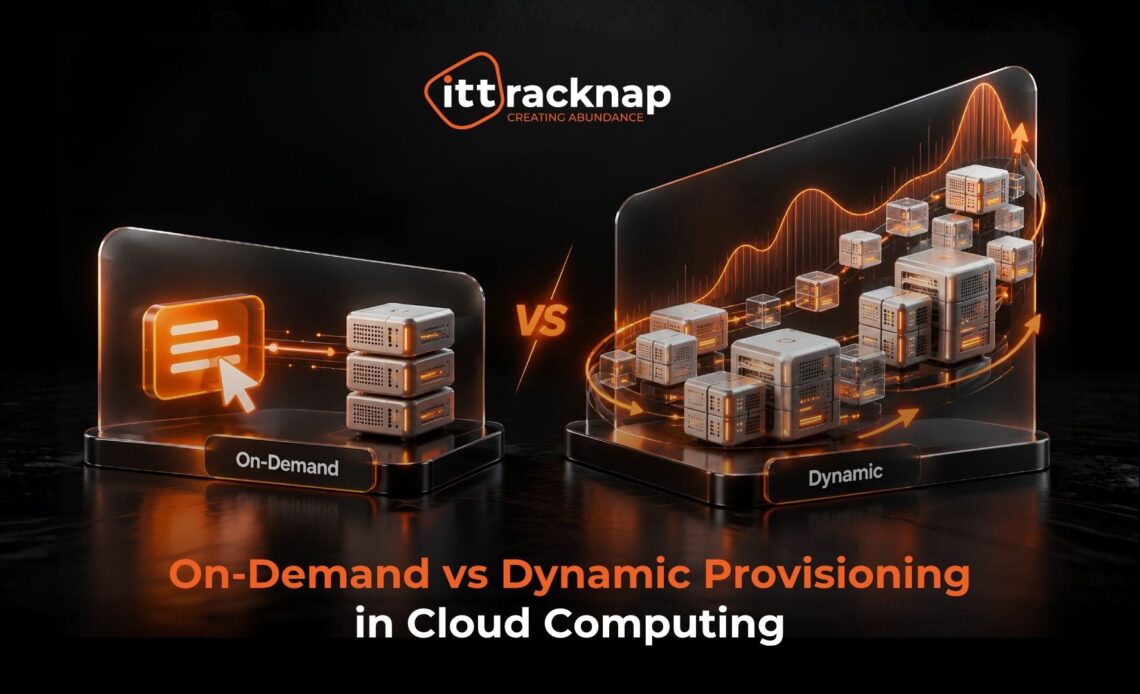
On-demand provisioning delivers cloud resources the moment a user asks for them. Dynamic provisioning adjusts resources automatically as workload changes, without anyone asking. Both make the cloud feel instant, but they solve different problems, and the terms are often confusing.
For cloud service providers (CSPs), managed service providers (MSPs), and SaaS businesses, the difference matters. It affects how customers buy services, how infrastructure scales, and how usage turns into accurate invoices.
This guide explains what on-demand provisioning and dynamic provisioning mean in cloud computing, how each works, how they compare, and how they work together. If you’re new to the topic, start with our overview of cloud provisioning and its types.
What Is On-Demand Provisioning in Cloud Computing?
On-demand provisioning is the delivery of cloud resources as soon as a user requests them, with no manual approval or setup by IT staff. The user picks what they need from a portal, marketplace, or API, and the platform provisions it within minutes.
It reflects “on-demand self-service,” one of the five essential characteristics of cloud computing defined by NIST. That is why on-demand provisioning is closely tied to user self-provisioning, and the two terms are often used interchangeably.
How On-Demand Provisioning Works
On-demand provisioning automates service delivery, allowing customers to access the resources they need quickly without manual intervention.
The process typically follows these five steps:
- Request: A user selects a service, plan, or resource from a self-service portal or calls an API.
- Validation: The platform checks permissions, credit limits, quotas, and policies.
- Fulfillment: The resource is created automatically, such as a VM, a storage bucket, or a set of software licenses.
- Activation: The user gets access and credentials, and the subscription starts.
- Billing: The new service is added to the customer’s subscription and invoiced.
Examples of On-Demand Provisioning
On-demand provisioning can be used across cloud, SaaS, and managed services to deliver resources instantly when customers request them. Here are a few common examples:
- A customer buys 25 Microsoft 365 licenses from a provider’s storefront and gets them activated immediately.
- A developer launches a virtual machine from a cloud console for a test environment.
- An MSP’s client adds backup storage for a new office through a branded customer portal.
The key trait in every example is that a person triggers the provisioning.
What Is Dynamic Provisioning in Cloud Computing?
Dynamic provisioning is the automatic allocation and release of cloud resources based on real-time workload. When demand rises, the system adds capacity. When demand falls, it removes capacity, so you don’t pay for resources sitting idle.
It is the mechanism behind cloud elasticity and is usually implemented through autoscaling, orchestration, and monitoring tools. Unlike static provisioning, where capacity is fixed in advance for expected peak load, dynamic provisioning matches capacity to actual usage.
How Dynamic Provisioning Works
Dynamic provisioning automatically adjusts resources based on real-time demand, helping businesses maintain performance while avoiding unnecessary capacity.
- Monitoring: The platform tracks metrics such as CPU, memory, request rate, queue length, or storage use.
- Threshold or prediction: Scaling policies define when to act, for example adding an instance when CPU stays above 70% for five minutes. Some platforms also scale on predicted demand.
- Scale out or up: New instances, containers, or storage volumes are created automatically.
- Scale in or down: Once demand drops, extra resources are released.
- Metering: Every change is recorded, so usage can be billed accurately.
Examples of Dynamic Provisioning
Dynamic provisioning is commonly used in environments where resource requirements change continuously based on traffic, workload, or application demand. For example:
- An ecommerce site adds web servers during a festive sale and removes them afterward.
- A SaaS application scales its database read replicas during business hours.
- A Kubernetes cluster creates storage volumes automatically when an application needs them.
The key trait here is that the system triggers the provisioning, based on demand.
On-Demand vs Dynamic Provisioning: Key Differences
The simplest way to tell them apart is to ask what triggers the provisioning: a user’s request or a change in workload.
| Factor | On-Demand Provisioning | Dynamic Provisioning |
| Trigger | A user or customer request | Real-time workload metrics or predictions |
| Who initiates | People (customers, developers, admins) | The platform, through scaling policies |
| Main goal | Fast, self-service access to services | Matching capacity to changing demand |
| Timing | When a request is placed | Continuously, as demand changes |
| Typical tools | Self-service portals, marketplaces, APIs | Autoscaling, orchestration, monitoring |
| Direction | Mostly adds new services or subscriptions | Scales up and down automatically |
| Cost model | Subscription or pay-as-you-go per service | Usage-based, varies hour to hour |
| Control | User decides what and when | Policies decide how much and when |
| Best for | Ordering licenses, VMs, storage, new environments | Variable traffic, seasonal peaks, SaaS workloads |
| Related pillar type | User self-provisioning | Dynamic provisioning |
In short, on-demand provisioning answers “How quickly can a customer get a service?” Dynamic provisioning answers “How well does that service keep up with demand?”
How On-Demand and Dynamic Provisioning Work Together
Most cloud services use both: on-demand provisioning starts the service, and dynamic provisioning keeps it running at the right size.
Consider a retail customer of a cloud provider:
- Order (on-demand): The customer buys a hosting plan with an autoscaling web tier from the provider’s storefront.
- Instant setup (on-demand): The platform provisions the servers, storage, and network, then activates the subscription.
- Traffic spike (dynamic): During a sale, traffic triples, and autoscaling adds web servers automatically.
- Scale back (dynamic): After the sale, extra servers are released.
- Invoice (both): The bill combines the fixed plan fee with metered charges for the extra capacity used.
The customer only acted once, in step 1. Everything after that ran on policy. For providers, the challenge is keeping orders, scaling events, and billing in sync.
Benefits and Challenges of Each Model
The act of understanding these benefits and challenges help businesses choose the right approach for their operations.
On-Demand Provisioning
Benefits
- Faster time to service: Customers get resources in minutes instead of waiting on tickets or manual setup.
- Better customer experience: Self-service portals let customers buy and manage services whenever they want.
- Lower support workload: Fewer manual orders mean IT and support teams spend less time on routine requests.
- More sales opportunities: An always available storefront makes it easy to add upsells and add-ons.
Challenges
- Governance: Without quotas and approval rules, users can over-order or create unused resources.
- Catalog complexity: Every service needs clear plans, pricing, and automated fulfillment behind it.
- Integration effort: Each vendor, such as Microsoft, AWS, or Acronis, needs a working provisioning connection.
Dynamic Provisioning
Benefits
- Performance under load: Applications stay responsive during traffic spikes.
- Lower waste: Capacity is released when it isn’t needed, unlike static provisioning sized for peak load.
- Less manual capacity planning: Policies handle routine scaling decisions.
Challenges
- Unpredictable costs: Usage can change hour to hour, which makes budgets and invoices harder to forecast.
- Policy tuning: Thresholds set too low cause constant scaling; set too high, they cause slowdowns.
- Monitoring needs: Dynamic provisioning depends on accurate, real-time metrics.
- Billing accuracy: Every scaling event has to be metered and rated correctly.
What Both Models Mean for Cloud Billing
For CSPs and MSPs, provisioning is only half the job; every provisioned resource also has to be billed correctly. The two models create different billing demands.
On-demand provisioning creates subscription events. Each order, upgrade, downgrade, or cancellation must update the customer’s subscription, often mid-cycle. That requires prorated charges, renewal tracking, and a clear record of who ordered what and when.
Dynamic provisioning creates usage events. Every scale-out or scale-in changes consumption. Providers need to collect usage data from vendors, apply their own pricing and margins, and turn it into an invoice the customer understands.
When these processes run on spreadsheets or disconnected tools, common problems follow: unbilled usage, revenue leakage, invoice disputes, and slow month-end closes. Connecting provisioning and billing in one platform removes most of that manual reconciliation.
How RackNap Supports On-Demand and Dynamic Provisioning
RackNap gives cloud providers one platform to sell, provision, and bill cloud services, whether resources are ordered by customers or scaled by workload.
- Self-service storefront and portal: Customers and resellers order services on demand through a white-labeled customer portal and marketplace.
- Automated order fulfillment: Order & fulfillment automation provisions services with vendors such as Microsoft 365, Microsoft Azure, AWS, Google Workspace, and Acronis.
- Subscription management: Upgrades, downgrades, renewals, and cancellations update subscriptions automatically.
- Usage-based billing: Billing and pricing management turns consumption data into accurate invoices with your own pricing, margins, and discounts.
- Multi-tier partner management: Resellers and sub-resellers can provision and bill their own customers through partner channel tools.
Conclusion
On-demand provisioning and dynamic provisioning are not competing choices. On-demand provisioning gives customers instant access to the services they order, and dynamic provisioning keeps those services sized to real demand.
For cloud providers, the real advantage comes from connecting both to billing, so every order and every scaling event is captured and invoiced correctly.
Want to automate provisioning and billing across your cloud services? Schedule a demo of RackNap today.
FAQs
1. What is on-demand provisioning in cloud computing?
On-demand provisioning is the immediate delivery of cloud resources when a user requests them through a portal, marketplace, or API, without manual setup by IT staff.
2. What is dynamic provisioning in cloud computing?
Dynamic provisioning is the automatic allocation and release of cloud resources based on real-time workload, so capacity grows during peaks and shrinks when demand drops.
3. What is the difference between on-demand and dynamic provisioning?
On-demand provisioning is triggered by a user’s request. Dynamic provisioning is triggered by changes in workload and runs automatically through scaling policies.
4. Is on-demand provisioning the same as user self-provisioning?
They are closely related. User self-provisioning describes the self-service model, and on-demand provisioning describes the result: resources delivered as soon as they are requested.
5. Is dynamic provisioning the same as autoscaling?
Autoscaling is the most common way to implement dynamic provisioning. Dynamic provisioning is the broader concept and also covers storage, network, and container resources.
6. What is the difference between static and dynamic provisioning?
Static provisioning allocates a fixed amount of capacity in advance, usually sized for peak load. Dynamic provisioning adjusts capacity continuously based on actual demand.
7. Can a cloud service use both on-demand and dynamic provisioning?
Yes. Most do: a customer orders a service on demand, and dynamic provisioning then scales it as usage changes.
