

“52% of organizations are on-board with the digital revolution as Market Disruptors, Market Makers or Business Re-inventors (compared to 46% in 2016).” – 451 Research.

Technology is transforming businesses at a fast pace. Fueled by advances in connectivity and networks, cloud technology is leading to a global trend of digital transformation that is causing disruption in every industry.
“Dramatic workload migration over the next two years: from 41% currently to 60% expected in two years” – 451 research.
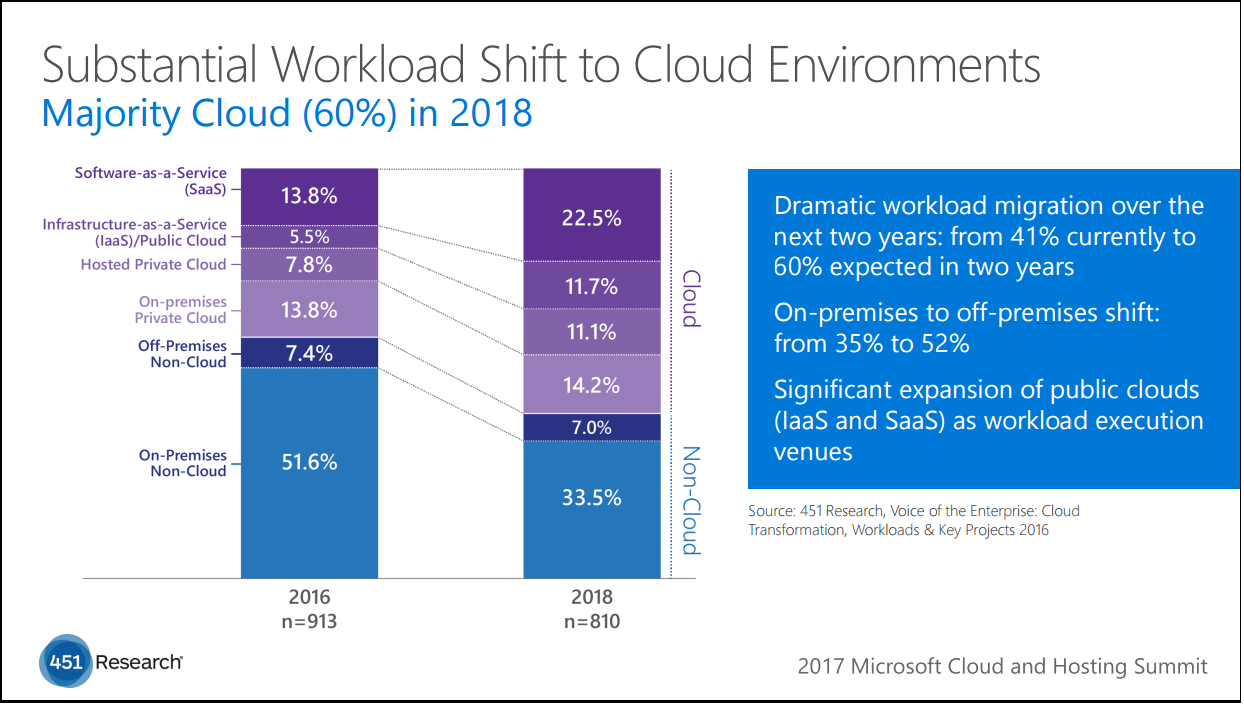
Cloud’s unique business value propositions like flexibility and agility help organizations perform better and thus, service providers are realizing the business value they can get by monetizing the cloud trend and selling cloud services.
Economics of Cloud Selling
Different service providers charge for the cloud on different basis. Cloud solutions may be priced depending upon the resource usage metrics – bandwidth, RAM, storage etc. or/and cloud pricing is fixed for a particular amount of time – hourly, monthly etc.
However, cloud selling is vastly different from selling traditional IT services as cloud providers help shift an organization’s IT budgets from capital expenditure to operational expenditures. But the one thing that’s important is that everything is upfront, is readily calculated and recurs at a fixed period of time and for the cloud solution providers, that translates to a recurring revenue stream.
This recurring revenue attracts the service providers towards selling cloud services, but the customers today need much more than just cloud. They require managed cloud services and are willing to pay a premium for them.
“Half of All Organizations Consider Service Providers As Vital For Future Digital Transformation Projects. 60% of These Look to Service Providers for Sourcing, Implementation and Management and Would Be Willing to Pay a 2X Premium for a “One Throat to Choke” Trusted Advisor Solution” – 451 Research.
Customers seek a managed cloud provider who can assist them to get maximum out of their cloud environment. Customers prefer a managed service:
- As it is easier to budget with predictable monthly outcomes.
- Reduces on-premise cost and with automation of business processes frees up the resources from manual clerical tasks.
- The pro-active strategies are much better than the reactive ones, as in the former you can be well-prepared in advance for any threat with the help of routine monitoring and management of tasks.
Here, an MSP gets the opportunity to get into a long-term end-to-end relationship with customers. If you are a service provider and are willing to get into the cloud management business, here is a graphics from Microsoft that will give you an idea of how much the managed services’ practice will cost you.

Best practices for selling cloud services
“IDC forecasts cloud spending will exceed $500B.”
To make the best use of this opportunity, a managed cloud service provider needs to think of strategies that will differentiate him from the competitors. As a service provider, you need to:
Differentiate your service offering
The customer should be provided a reasonable reason for choosing you as a service provider. You should know what services are a “must-have” and how can you add some distinct service features to a product to increase its market value. That will be easier if you know what your current offerings are and how they can be modernized to make a comprehensive solution.
Modernize your sales and marketing strategies
Now the focus is on customer-centric strategies and not the product-centric ones. Think about how you can use your inbound and outbound marketing strategies to educate your customers and make them more aware of the product or the business value they can get from it.
Optimize your customer’s business operations
The managed offerings should help in optimizing business operations. The customer should find solid changes in the pre-and post-migration environment. As the business model is different, so are the operations. You should equip them with tools that will help them automate their business operations and cut down the manual jobs.
Deliver customer lifetime value
Cloud is here to stay. Hence, instead of delivering a one-time benefit to the customers, think about lifetime value proposition. Be the trusted advisor, and help customers to identify new opportunities with managed services and how they can get digitally empowered by accepting the change.
Go for business automation
Successful cloud MSPs act as a one-stop-destination for customers by providing common provisioning, subscription billing and support for multiple cloud products under one roof. For that, they make use of a cloud business automation platform like RackNap that can provide faster time to market.
It also manages all business operations, including billing, pricing, support, inventory, partner management –with complete automation. Automation is the key for faster GTM strategies.
Cloud MSPs have a bright future in the market with cloud quickly becoming the part of organizations’ strategic moves, and with CIOs identifying cloud as the harbinger of change and driver of digital transformation.
Being a cloud MSP means, that you will help your customers transition to the cloud and will guide them at every step of this journey, managing their complete business operations, billing, pricing etc. at one place to avoid complications.
If you need any help in becoming an MSP or in optimizing your business operations, get in touch with us [email protected].