
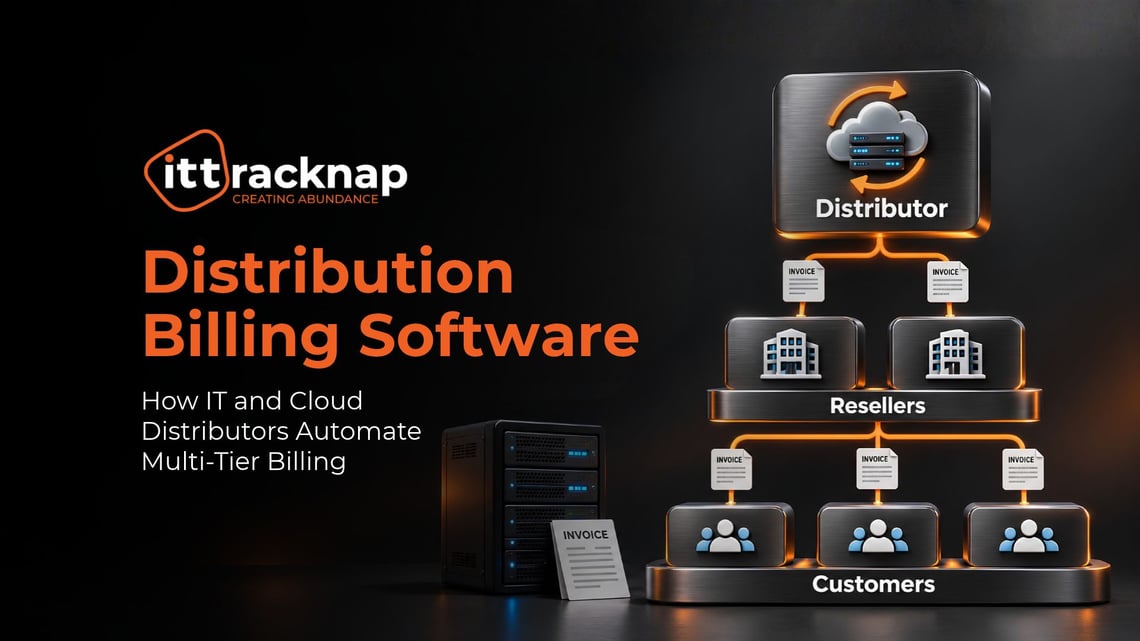
Distribution Billing Software: How IT and Cloud Distributors Automate Multi-Tier Billing
Quick Answer: IT and cloud distributors use specialized billing software to automate subscription invoicing, reseller pricing, usage charges, and revenue reconciliation. Solutions range from cloud distribution platforms such as RackNap to ERP systems, standalone billing tools, and spreadsheets.
RackNap’s distribution management software connects recurring billing, multi-tier pricing, and subscription management within one system. It helps distributors manage complex billing relationships without relying on disconnected spreadsheets and manual invoice calculations.
What Billing Software Do IT and Cloud Distributors Use?
IT and cloud distributors choose billing solutions based on their subscription volume, vendor relationships, reseller network, and automation requirements.
|
Software Type |
Best Suited for |
Main Consideration |
|
Cloud distribution platforms such as RackNap |
Distributors managing multiple vendors, resellers, and recurring subscriptions |
Combines billing with subscription and reseller operations |
|
Cloud marketplaces with separate billing tools |
Businesses with an existing marketplace and billing infrastructure |
Requires reliable integration between systems |
|
ERP systems with custom billing |
Large distributors with established ERP environments |
Cloud subscription rules may require customization |
|
Spreadsheets and accounting software |
Smaller distributors with limited transactions |
Manual work increases as subscriptions grow |
Specialized distribution billing software becomes more valuable when businesses manage different vendor pricing models, frequent subscription changes, and reseller-specific margins.
What Is Distribution Billing Software, and Why Do Cloud Distributors Need It?
Distribution billing software automates subscription charges, reseller invoicing, pricing calculations, and financial reconciliation across multiple sales channels.
Traditional distribution businesses primarily manage product purchases and inventory, while cloud distributors handle subscriptions that change throughout their lifecycle.
A distributor selling Microsoft 365, Microsoft Azure, and Acronis Cyber Protect Cloud may need to manage several billing models at once. These include recurring license fees, consumption-based charges, reseller discounts, subscription renewals, and customer-specific billing agreements.
Without automation, finance teams must compare vendor records, calculate reseller margins, and prepare invoices across separate systems. Modern distributor billing software connects these activities, helping businesses keep accurate billing records as their subscription portfolios expand.
How Do Distributors Bill Resellers and End Customers for Cloud Subscriptions?
Cloud distributors typically purchase services from vendors, apply reseller-specific pricing, and invoice partners according to their commercial agreements. Resellers then bill end customers using their own pricing structures, which creates multiple billing relationships within the distribution network.
The process generally involves three levels:
- Vendor to distributor: The vendor charges the distributor according to subscription terms, license quantities, or resource consumption.
- Distributor to reseller: The distributor applies agreed wholesale pricing, discounts, and billing conditions.
- Reseller to customer: The reseller applies its customer pricing and generates the final invoice.
How Does Multi-Tier Billing Work in Practice?
Consider an illustrative monthly subscription with 100 licenses, using hypothetical prices that do not represent actual Microsoft licensing rates.
|
Price Level |
Monthly Price per License |
Total Monthly Amount |
|
Vendor to distributor |
$10 |
$1,000 |
|
Distributor to reseller |
$12 |
$1,200 |
|
Reseller to customer |
$15 |
$1,500 |
The distributor earns a $200 gross spread, while the reseller earns $300 before their respective operating expenses. If the customer adds 20 licenses halfway through the month, eligible prorated charges must be calculated using the applicable billing rules.
RackNap supports automated subscription adjustments and prorated calculations, reducing the manual effort required to manage changing license quantities.
What Billing Challenges Do IT and Cloud Distributors Face?
The main challenges involve different vendor billing models, changing subscription quantities, reseller-specific pricing, and complex reconciliation requirements.
1. Different Vendor Billing Models
Microsoft 365 generally uses license-based subscriptions, while Microsoft Azure includes consumption-based services and reserved capacity options. Acronis Cyber Protect Cloud is typically billed by workload or storage consumed, so distributors must calculate charges according to each vendor’s billing terms.2. Reseller-Specific Pricing
Different resellers may receive negotiated discounts, margin structures, or billing conditions based on their commercial agreements. The billing system must apply these rules consistently without requiring manual adjustments for every transaction.
3. Subscription Renewals and Cancellations
Microsoft CSP subscriptions follow New Commerce Experience (NCE) rules governing subscription terms, renewals, cancellations, and license reductions.
For eligible license-based subscriptions, Microsoft generally allows cancellation with a prorated refund within seven days of purchase or renewal.
Distributors should follow the latest Microsoft NCE cancellation documentation when configuring billing workflows.
4. Vendor Invoice Reconciliation
Finance teams must compare vendor charges with reseller invoices to identify missing transactions, incorrect quantities, and pricing discrepancies. Automated reconciliation helps detect these exceptions before they affect financial reporting or customer relationships.
What Features Should Billing Software for Distributors Have?
Effective billing software for distributors should support multiple pricing models, automated invoicing, subscription changes, and vendor reconciliation.
|
Feature |
Business Benefit |
|
Multi-tier pricing |
Maintains separate distributor, reseller, and customer prices |
|
Subscription invoicing |
Automates recurring invoices across billing cycles |
|
Usage-based billing |
Calculates charges from service consumption |
|
Proration |
Adjusts eligible mid-cycle subscription charges |
|
Multi-vendor reconciliation |
Compares supplier charges with downstream invoices |
|
Multi-currency support |
Supports billing across different markets |
|
Tax management |
Applies configured tax rules |
|
Revenue analytics |
Provides visibility into revenue and margins |
|
API integrations |
Connects vendor, billing, and accounting systems |
The required features depend on whether a distributor primarily sells license-based software, consumption-based cloud services, or both.
How Can Cloud Distributors Automate Multi-Tier Billing?
Cloud distributors can automate multi-tier billing by connecting subscription data, reseller pricing, invoice calculations, and financial reconciliation. A practical implementation follows five steps:
- Centralize subscription data: Consolidate vendor products, customer accounts, license quantities, and billing terms into a consistent record.
- Configure reseller pricing: Define partner-specific rates, discounts, margins, and billing frequencies according to commercial agreements.
- Connect vendor systems: Capture subscription changes, renewals, and usage records through supported integrations.
- Automate invoice calculations: Apply recurring charges, consumption fees, taxes, and eligible prorated adjustments.
- Reconcile billing records: Compare vendor invoices against reseller charges and investigate exceptions before closing the billing cycle.
For related processes, explore How Cloud Distributors Can Simplify Partner Management and Procure-to-Pay for Technology Distributors.
How Does RackNap Simplify Billing for Technology Distributors?
RackNap connects subscription billing, pricing management, provisioning, and reseller operations within a unified cloud commerce system. Its capabilities support distributors that manage recurring subscriptions, consumption-based services, and multiple reseller relationships.
- Automated recurring billing: RackNap supports recurring charges, usage-based billing, and subscription lifecycle changes through configured billing workflows.
- Reseller-specific pricing: Distributors can configure different pricing structures and commercial conditions across partner relationships.
- Microsoft 365 automation: It supports subscription provisioning, renewals, invoice management, and prorated calculations. Explore Microsoft 365 billing automation.
- Azure consumption billing: RackNap supports prepaid and postpaid billing, usage thresholds, credit limits, and overconsumption invoices through Microsoft Azure CSP automation.
- Multi-vendor reconciliation: It’s Enterprise plan includes capabilities for reconciling charges across multiple vendors.
- Revenue visibility: Centralized billing records and reporting help distributors monitor subscription activity, invoice values, and revenue performance.
These capabilities allow distributors to connect billing with subscription activity instead of managing each process independently.
How Much Does Distribution Billing Software Cost?
Distribution billing software pricing varies according to vendor integrations, subscription volumes, reseller complexity, and required enterprise capabilities.
RackNap publishes three subscription plans for cloud businesses and technology distributors.
|
RackNap Plan |
Published Price |
Key Capabilities |
|
Standard |
$10,000/month |
Subscription billing engine, up to 11 active products, single-currency billing |
|
Enterprise |
$25,000/month |
Unlimited products and SKUs, multi-vendor reconciliation, advanced partner tiers, multi-currency and tax support |
|
Premium |
Custom pricing |
White-label marketplace, dedicated success manager, SLA-backed 24/7 support, optional on-premises deployment |
All three plans have additional setup and transaction fees, and prices reflect RackNap’s published plans as of November 2026.
The Enterprise plan suits distributors that need broader product catalogs, advanced partner structures, and multi-vendor reconciliation. Review the RackNap pricing plans for current commercial details.
How Can Distributors Choose the Right Billing Software?
The right billing software should match the distributor’s vendor portfolio, reseller relationships, subscription complexity, and financial processes. Before selecting a solution, evaluate whether it can:
- Support recurring, usage-based, and hybrid billing models across every vendor you sell.
- Apply separate pricing rules and margins across each reseller tier.
- Connect with your required vendor platforms and accounting systems.
- Reconcile vendor charges automatically and flag billing discrepancies for review.
- Handle growing transaction volumes and expansion into new countries and currencies.
A product demonstration should test actual billing scenarios, including mid-cycle license additions, reseller discounts, and vendor invoice reconciliation.
Frequently Asked Questions
1. What Is Billing Software for Distributors?
Software built for distributors automates subscription charges, reseller invoicing, pricing calculations, and reconciliation across vendors and sales channels.
2. Can Distributor Billing Software Handle Microsoft CSP Subscriptions?
Yes, compatible solutions such as RackNap support Microsoft CSP subscription billing, renewals, and Microsoft Azure consumption workflows.
3. How Is Distribution Management Software Different from Billing Software?
Distribution management software covers broader operations such as partner management, orders, and fulfillment, while billing software focuses on invoicing and financial calculations.
4. Can Cloud Distributors Automate Usage-Based Billing?
Yes, usage-based billing systems calculate charges from consumption records and configured pricing rules, reducing manual invoice preparation.
5. How Does Automated Billing Help Reduce Revenue Leakage?
Automated billing helps identify missing charges, incorrect quantities, and reconciliation discrepancies before they create financial losses or billing disputes.
Ready to Simplify Multi-Tier Distribution Billing?
As cloud distribution businesses expand, manual billing becomes increasingly difficult across vendors, resellers, and subscription models. RackNap helps technology distributors centralize recurring billing, usage calculations, reseller pricing, and reconciliation within connected workflows.
Book a demo to discover how RackNap can simplify billing operations and support your growing distribution business.
